Masculinity and Military Identity
The SympathizerMasculinity and Military Identity links military status to a broader and increasingly unstable measure of manhood. In the novel, military service can restore dignity to men reduced by exile to low-paid work and social invisibility; family roles can offer meaning, yet also become standards by which men condemn themselves. The same ideal that promises purpose demands sacrifice and violence, and can leave those who cannot fulfill it seeing themselves as no longer men at all.
Exile and the Loss of Status
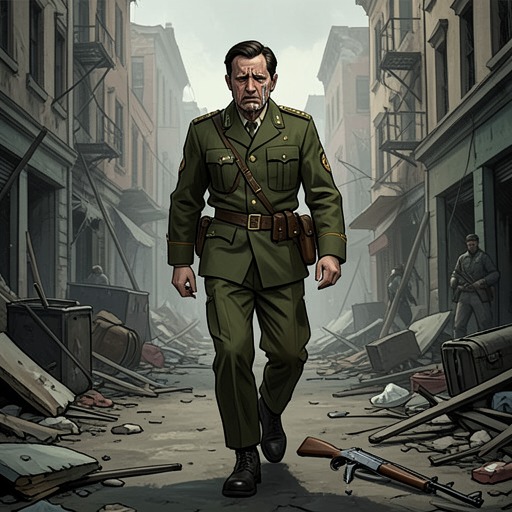
Among the exiled South Vietnamese men, the loss of military rank is not merely a loss of employment. The unnamed narrator, serving as The General’s aide, knows former commanders who now work as a pizza-parlor proprietor, a janitor, a mechanic, a short-order cook, or a deliveryman. Many others collect welfare or remain underemployed. The men who once exercised authority over soldiers have become socially marginal, and the narrator describes their pride as surviving alongside little else of their former power.
Their altered family lives sharpen that humiliation. The men remember their wives through a nostalgic image of feminine dependence, while many wives have had to find paid work. Their children answer back in a language they learn faster than their fathers. Some men interpret these ordinary changes as evidence that their households have been contaminated by the West, displacing the source of their loss onto the women and children around them. The crapulent major’s complaint that men no longer need to be providers registers the reversal he resents: in exile, women have acquired an independence that makes their husbands feel unnecessary.
The unnamed narrator suspects that the veterans’ memories of their wives have been remade by nostalgia; in Vietnam, he had not heard them speak so fondly of their marriages. His suggestion that The crapulent major move and seek a fresh start meets a practical answer: the major stays where he is because that is where the best Chinese food is. The exchange gives his grievance a prosaic counterweight. His sense of lost manhood is real to him, but it coexists with habits, preferences, and domestic circumstances that resist the grand story he tells about decline.
The Uniform and the Return of the Soldier
The General’s effort to form an exile army offers a public remedy to this diminished status. He has spent more than a year assembling a nucleus of experienced volunteers through officers, trusted noncommissioned officers, and enlisted men. His plan is to restore discipline, condition their bodies, prepare their minds, and make them imagine a future as a fighting unit. The organization includes headquarters and rifle platoons, as well as a heavy-weapons platoon on paper, though it has no heavy weapons yet.
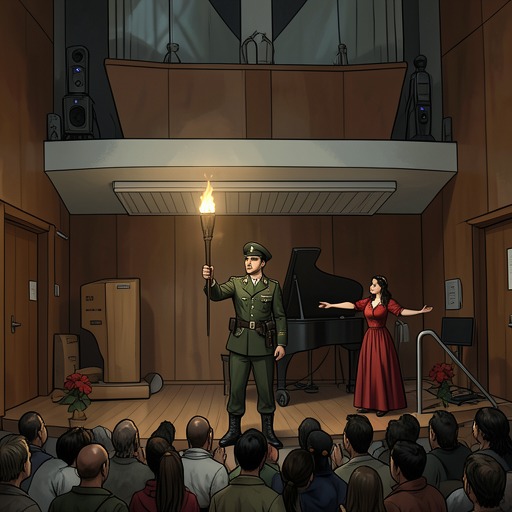
At a training gathering, the men sit on the ground while The General addresses them in camouflage, a red beret, polished boots, and insignia. The unnamed narrator photographs the scene. He observes how different the men look in uniform from their civilian working clothes as busboys, gardeners, fishermen, laborers, and custodians. Field caps conceal their ragged hair; their backs straighten, and they march rather than shuffle. The uniform does not change their exile or supply the weapons the army lacks, but it makes visible a military identity that their civilian lives have obscured.
The General calls the men leaders and asks them to sacrifice themselves for the people, promising that they will return to liberate those denied freedom. The men rise and cheer. The unnamed narrator recognizes the force of this appeal even as the identity of the people, and what they want, remains unanswered. The scene thus holds restoration and uncertainty together: the uniform enables men to experience themselves again as soldiers, while the political abstraction of the people gives their renewed identity a purpose whose meaning is left unresolved.
Bon’s Crisis of Manhood
Bon gives the cost of this ideal its most personal expression. He describes exile as confinement in an apartment that feels like a jail without bars. In his account, the Americans first promised freedom in exchange for obedience and then rescued the men after defeat, leaving them stripped of their power and voice. His anger turns inward as much as outward: he faults the exiles for allowing themselves to be reduced and refuses the reassurance that they remain men simply because they once served as soldiers.
For Bon, manhood depends on protecting a wife and children, being willing to die for family, country, and comrades, and not having to watch them die first. He condemns himself because he survived while men from his company are dead or imprisoned. He also condemns exiled men who shout at or sometimes beat their families to demonstrate a masculinity they have lost elsewhere. Violence at home, in this account, is not proof of strength but a grotesque substitute for the protective duty that Bon believes defines a man.
Earlier, Bon locates a different kind of purpose in becoming a son, husband, and father. He remembers feeling that he had betrayed his father by placing his marriage ahead of revenge, then finding meaning in the wonder of recognizing his own features in his infant son. Fatherhood allowed him to understand himself as part of a continuity between generations, and to feel that he had not abandoned his father after all. Later, after losing his family and former life, he interprets that meaning as gone. His movement from love and creation to despair makes his crisis more than wounded military pride: the roles that once sustained him have been taken from him, and he concludes that only action can keep him from being nobody.
Violence, Sexuality, and the Tests of Manhood
Violence repeatedly appears as a way men impose or test masculine authority. When Bon catches teenage shoplifters in his liquor store, he reaches for a baseball bat and threatens them until they surrender the stolen goods and beg forgiveness. The unnamed narrator connects this punishment to a culture of corporal discipline in homes and schools, where adults beat children and students. In that setting, violence is presented as an inherited method of instruction: Bon teaches the youths through the kind of force that taught him.
The ideal of manhood also informs how Bon understands killing. At a billiards hall, he offers to kill a man on the unnamed narrator’s behalf, but the narrator knows he cannot accept the offer. He sees killing as a threshold separating those who have killed from those who have not, and as a rite with no sacrament to acknowledge its gravity. Bon, by contrast, argues that killing gives access to a knowledge people are glad to use but unwilling to discuss. His offer is at once an act of comradeship and a claim that the capacity to kill confers a kind of hard-won standing.
A different pressure appears when Claude takes the men to a brothel. The grizzled captain and the affectless lieutenant enter, but Bon refuses and says he will walk. Claude tries to draw him inside by presenting the visit as something a good friend should accept for another man’s sake. The unnamed narrator offers to accompany Bon instead. The episode places sexual access among the social tests of masculine conduct, while Bon’s refusal exposes how such expectations can be imposed even by men who frame them as camaraderie.
Military Identity as Restoration and Trap
The novel does not treat military identity as either a simple recovery of lost dignity or a simple cause of harm. The General’s uniformed force gives displaced men a visible collective role and a language of leadership after their civilian lives have made them seem like an undifferentiated laboring mass. Yet the promise of renewed purpose is tied to an expectation of sacrifice, and the men’s readiness to cheer does not resolve what they are being asked to sacrifice themselves for.
Bon makes the trap clearest. He understands protection and sacrifice as the measures of a man, but judges himself by those standards after war has taken his family, comrades, and place in the world. His despair turns the same ideal that once gave his life meaning into a weapon against himself. Through the contrast between the restored posture of the men in uniform and Bon’s conviction that he is no longer a man, the novel presents military masculinity as both a source of solidarity and a brittle measure of worth—one that exile, bereavement, and defeat can make impossible to satisfy.